
Rann Utsav Tent Stay vs Bhuj Hotel: Which Is Better for Your December Trip?
Rann Utsav is a seasonal tent settlement at Dhordo, right at the edge of the White Rann. The 2026–27 season runs from 1 November 2026 to 7 March 2027, so December is squarely in the middle of it. It's built every winter, which means it has its own rhythm: scheduled cultural programmes in the evening, fixed meal timings, organised trips to the salt.
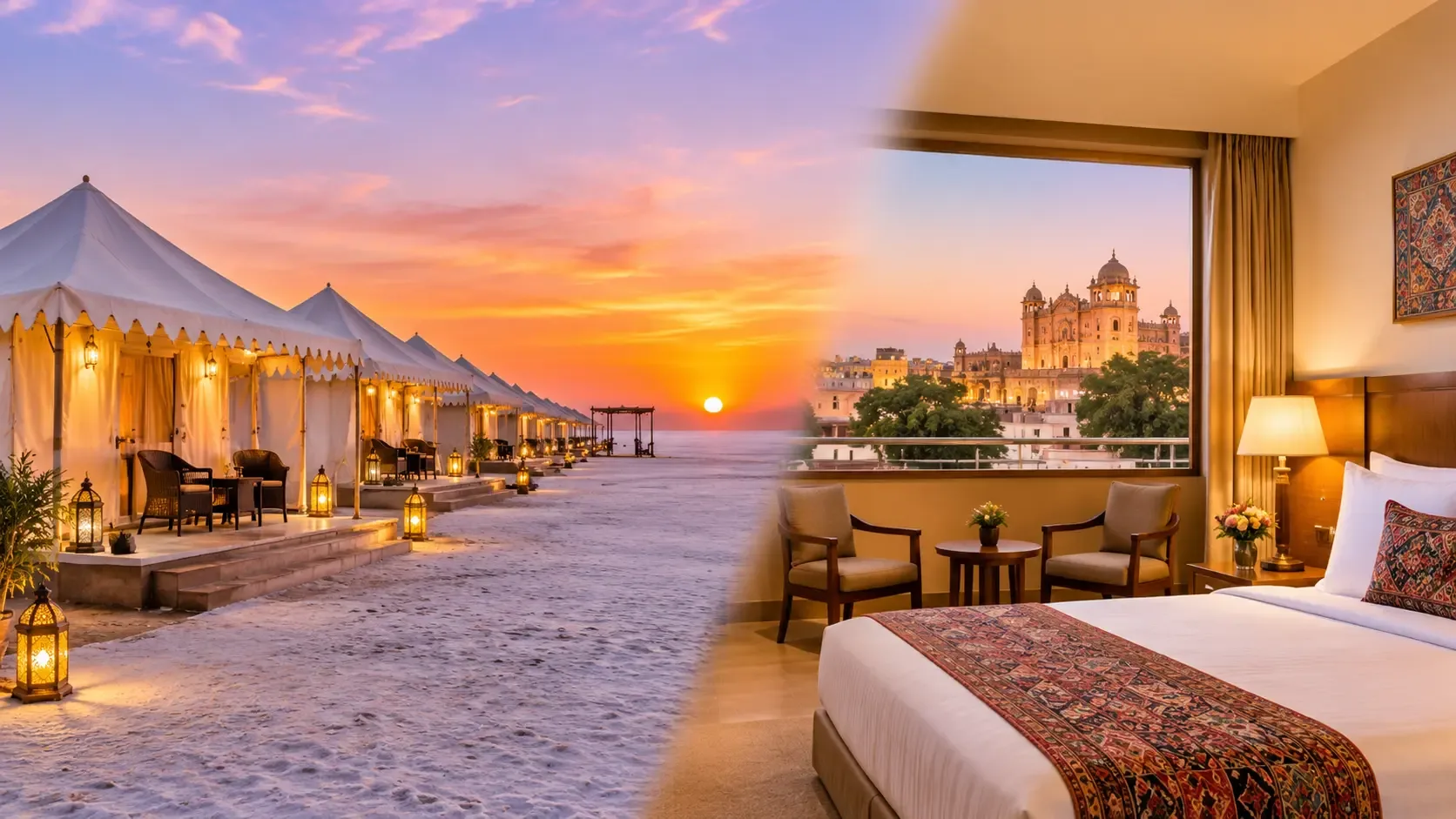
Picture this. It's 5:30 pm in December and you're standing on the White Rann. The salt is turning from white to pink to a pale lavender, and the whole horizon seems to have gone quiet. Then you remember that your hotel is in Bhuj, about 80 km and nearly two hours away, and the road back is dark.
That's the real question behind "tent or hotel?". It isn't about thread count or whether a tent feels fancy enough. It's about where you want to be when the best hours of the day arrive, and what it costs you to be there.
We plan Kutch trips every season, and this is the question we get asked more than any other. So here's an honest answer, with the trade-offs on both sides.
The short answer
Stay at the Tent City in Dhordo if the White Rann at sunset and sunrise is the point of your trip, if you want everything handled in one booking, or if you're travelling with a couple of days to spare for the Rann only.
Stay in Bhuj if you want to see more of Kutch than the salt flats, if you're travelling with a bigger group and want to share a cab, or if you need a proper hotel room (think heating, flexibility, a restaurant you can walk to).
Split your stay if you have three or more nights. One or two nights at Dhordo for the desert, the rest in Bhuj for everything else. This is what we suggest to most first-time visitors, and we'll explain why further down.
First, what you're actually choosing between
Rann Utsav is a seasonal tent settlement at Dhordo, right at the edge of the White Rann. The 2026–27 season runs from 1 November 2026 to 7 March 2027, so December is squarely in the middle of it. It's built every winter, which means it has its own rhythm: scheduled cultural programmes in the evening, fixed meal timings, organised trips to the salt.
Bhuj is the nearest proper town, about 80 to 85 km from Dhordo. A normal city, with normal hotels, markets, palaces and museums. It's also where the airport and railway station are, so you'll pass through it either way.
One is a destination built around one experience. The other is a base for exploring everything. Neither is wrong. They just solve different problems.
The stay itself
At the Tent City, you're sleeping in the desert, or at least on the edge of it. Tents come in tiers (a non-AC Swiss cottage at the simpler end, then premium and super premium tents above that). Meals, an evening cultural programme and a sunset trip to the White Rann are part of the package. You wake up, step outside, and you're in Kutch. It feels like a trip rather than an overnight stop, and that matters more than people expect.
What it isn't: a quiet luxury resort. It's busy, especially around full moon and holiday dates, and the schedule is fairly structured. If you like to wander off and eat at a local place at 9 pm, you'll feel that.
In a Bhuj hotel, you get a regular hotel stay. Better choice at every price point, more flexibility on food and timing, and the comfort of a solid room on a cold night. December nights in Kutch can be properly chilly, and for some travellers (especially older ones, or those with small children), a real room with real walls is worth a lot.
What it isn't: close to the Rann. Which brings us to the thing most guides skip.
The transfer problem nobody mentions
This is where the two options really diverge.
Staying in Bhuj means the White Rann is a day trip, roughly 1.5 to 2 hours each way. For sunset, you leave Bhuj by mid-afternoon and come back in the dark. For sunrise, you're up before 4 am. You can do it, and plenty of people do, but you're spending three or four hours a day in a car, and sunrise at the Rann from a Bhuj hotel is a genuinely tough ask.
Staying at Dhordo flips that. Sunset is a short coach or camel-cart ride away. Sunrise is a gentle early alarm instead of a pre-dawn drive. Packages typically include a sunset trip, and sunrise usually comes with stays of two nights or more, so check this against what you're booking.
There's a catch, though. Tent City transfers from Bhuj run on fixed timings, using coaches that meet specific arrivals and leave at specific times. Some departure slots are very early in the morning. If your flight or train doesn't line up, you may need a private cab or a night in Bhuj either side. Always check the pickup and drop times against your travel before you pay.
One more thing: the White Rann sits in a border security zone, so you need an entry permit. Tent City guests usually have this sorted through their booking, but one popular guide we checked notes the permit may not be part of every package. If you're visiting as a day-tripper from Bhuj, you apply for it yourself on the official Gujarat government Rann permit portal (around ₹100 per adult at the time of writing, with lower fees for children). Carry a photo ID, and confirm current fees on the official site before you travel.
What it actually costs
This is where people get tripped up, because the two options aren't priced the same way.
Tent City is all-in per night. Published rates for the 2026–27 season (as listed on a travel guide updated in late September 2026, so treat them as a guide and confirm at booking) start at about ₹6,300 per person plus 18% GST for a non-AC Swiss cottage on regular dates, which works out to roughly ₹7,434 per person with GST. A Premium Tent on regular dates is about ₹9,300 plus GST, around ₹10,974 per person. On peak dates, the same premium tent climbs to roughly ₹15,700 per person per night with GST. That price covers your meals, the evening programme and the sunset trip.
A Bhuj hotel is cheaper on paper and more expensive in practice, because the room rate is only one line of the bill. When you compare, add up:
- The room itself
- Lunch and dinner (hotel breakfast is usually the only meal included)
- A private cab for the Bhuj–White Rann–Bhuj run, each day you go
- The White Rann permit
- Any extra transport for sunrise
The cab is the item that decides it. Ask for a quote on a full-day car, and then divide it by the number of people in your group. For two people, that cab cost hurts. For a group of four to six sharing one vehicle, it shrinks fast, and Bhuj often comes out cheaper per head.
A useful rule of thumb: couples and small groups get better value from the tent, larger groups and families sharing a car often get better value from Bhuj. Run your own numbers with real quotes, though, because dates change everything. December is high season, and the last week of the month is the busiest.
What about families and seniors?
This is where the "best" answer is least obvious.
For families with young children, the Tent City's biggest advantage is that there's no long road at the end of the day. Tired kids and a 2-hour drive after sunset is not a fun combination. The programme in the evening gives children something to do, too. On the other hand, tents get cold at night and are less forgiving if a child falls ill or needs a quiet room. Check what heating and bathroom arrangements your tent category offers before you commit.
For senior citizens, it depends on mobility and comfort needs more than anything. A hotel in Bhuj gives them a reliable room, easier access to medical help and a slower pace. But two 80 km drives in a day can be draining. The Tent City cuts out that driving, but it involves more walking across the grounds and getting on and off coaches. If you're travelling with older parents, a good compromise is one night at Dhordo and the rest in Bhuj, with a light schedule in between. We build many of our Kutch itineraries around exactly this.
Why we like the split stay
Most first-time visitors underestimate Kutch. The White Rann is the headline, but the region around it is rich. There's the hilltop view at Kalo Dungar, the handicraft villages near Bhuj, the beach at Mandvi, and the Vijay Vilas Palace. Staying only at the tent camp means you'll see the salt and not much else, while staying only in Bhuj means you'll see Kutch but treat the Rann like an errand.
So for a trip of three or four nights, we usually suggest one night at the Tent City, timed so you catch sunset and sunrise, and the remaining nights in Bhuj. If you'd like to see how that plays out, our Rann Utsav and Bhuj Mandvi tour is built around that kind of balance.
Planning your own Kutch trip
If you want the whole picture, start with our Rann of Kutch tour packages, which cover Bhuj, Dhordo, the White Rann, Kalo Dungar and Mandvi. For a shorter getaway, look at the Rann Utsav package. If you'd like a slower pace, our Kutch at Leisure package leaves room to breathe. And if Kutch is only one part of a bigger trip, the Kutch with Sasan Gir tour and the Kutch with Somnath Dwarka package tie it into the rest of the state.
While you're there, don't skip Lakhota Museum in Bhuj, or the Kutch Desert Wildlife Sanctuary if wildlife is on your list. Not sure which option fits your group? Get in touch with your dates and the number of travellers, and we'll help you work out the numbers. You can also call us on +91 7317742334 or message us on WhatsApp.
Frequently Asked Questions
Can I just visit the White Rann for a day from Bhuj?
Yes. You'll need a permit, and you should plan for roughly 1.5 to 2 hours each way. It works, but it makes for a long day, and sunrise is hard to manage.
Is one night at the Tent City enough?
For the sunset, yes. For sunrise as well, look at a two-night package, since sunrise trips often come with longer stays.
When is the best time to visit?
Winter, from November to February, is the right window, and sunrise and sunset are the best hours on the salt.
Can I customise the stay?
Yes, and we'd encourage it. Our itineraries are flexible, so you can combine a tent night with Bhuj hotel nights, add Mandvi, or extend to other parts of Gujarat.
Need Assistance With This Destination?
Our certified destination specialists can customize a hassle-free itinerary for you.
Popular Tours to Pair With This Blog
 4 Nights / 5 Days
Dwarka Somnath Tour Packages
Ahmedabad – Dwarka – Bet Dwarka – Porbandar – Somnath – Virpur – Gondal – Rajkot – Akshardham
 4 Nights / 5 Days
Wildlife and Beach Of Gujarat
Ahmedabad – Little Rann Of Kutch – Mandvi – Wankaner – Rajkot
 7 Nights / 8 Days
Gujarat Panch Dwarka Package
Ahmedabad – Dakor – Lothal – Rajkot – Dwarka – Porbandar – Somnath – Sasangir – Udaipur – Shrinathji
More Travel Blogs & Insights
Best Time to Visit Rann of Kutch: Month-Wise Guide for 2026–27
The best time to visit Rann of Kutch is from November to February, when the weather stays pleasant, the White Rann is accessible, and Rann Utsav brings music, crafts, food, and desert celebrations to Kutch. For the most comfortable experience, plan your trip around December or January; for fewer crowds, consider November or February. The ...

Gujarat Triangle Tour – Discover Gujarat’s Heritage, Culture & Hidden Treasures
Gujarat is an Amazing destination where you will find divine traditions, the palace cities, lively markets, and modern centers to make your vacation a memorable one. Explore the gorgeous beauty of the western Indian state by booking the Gujarat Triangle Tour – Visiting three beautiful destinations-Ahmedabad, Vadodara, and Surat. Celebrate the historical charm of each ...
Gujarat Tourism Package – Explore Gujarat’s Hidden Gems with Gujarat Package
A Trip to Spiritual, Historical, Natural & Cultural Place Gujarat a land of rich history, culture, spiritual belief, and natural beauty that makes your trip to Gujarat a memorable event. From beautiful temples and historical marvels to wildlife sanctuaries and colorful desert landscapes, the state of Gujarat provides a wide variety of un-ending attractions for ...